
Batch 2
Post Graduate Certificate in Agentic and RAG Systems for AI Engineering
Learn to Build, Ship and Scale Agentic AI and RAG Systems
Upcoming Application Deadline: Invalid liquid data
Invalid liquid data (Applicable Taxes will be charged at checkout)
Why Professionals Choose iHUB, IIT Roorkee's Agentic AI and RAG Programme?

Note:
Schedule for faculty masterclass will be shared post programme orientation.
Only live masterclasses delivered by IIT faculty and the weekly live sessions will be conducted by industry experts/ programme leaders.
This programme does not offer any placement/ salary guarantee
What You Will Learn
Go beyond using AI tools to understanding how AI systems are built.
Build your foundation in Python for AI engineering, LLM architectures, prompting, model ecosystems, and AI evaluation. Learn to work with proprietary and open-source models while balancing quality, latency, and cost. These are the core AI engineering skills this agentic AI engineering programme is built on.
You’ll learn: these will be bullet points
Python for AI Engineering
LLM Architecture
Prompt Engineering
Model Selection
LLM Evaluation
Reliability Testing
AI Is Moving From Experimentation to Production. Are Your Skills Keeping Up?
80%
20x
50%
About iHub DivyaSampark, IIT Roorkee
iHUB DivyaSampark, a Section 8 company (Non-Government Organisation), is a Technology Innovation Hub at IIT Roorkee established under the National Mission on Interdisciplinary Cyber-Physical Systems (NM-ICPS), initiated by the Department of Science & Technology (DST), Government of India. The Hub works towards fostering innovation, developing technology solutions, building skilled manpower and encouraging entrepreneurship to address emerging challenges across areas such as healthcare, Industry 4.0, smart cities and defence.
Through its training and capacity-building initiatives, iHUB DivyaSampark focuses on equipping learners and professionals with skills in emerging technologies. These initiatives are designed to foster innovation, critical thinking, adaptability and practical capabilities, enabling participants to contribute meaningfully to the evolving technology and digital ecosystem.
What Makes It Credible?
Established under NM-ICPS by the Department of Science and Technology, Government of India
Focuses on AI, Industry 4.0, Healthcare 4.0, and sustainable smart cities
Coordinated by a high-level interministerial committee headed by the CEO of NITI Aayog, with participation from MeitY, DST, and other Central Ministries
What Is the Agentic and RAG Systems for AI Engineering Course About?
Across the programme, you will:
Build production-grade RAG systems with advanced retrieval, reranking, evaluation and optimisation techniques.
Design and deploy Agentic AI systems using tool calling, LangGraph, memory, human-in-the-loop workflows and multi-agent architectures.
Learn model adaptation and fine-tuning using LoRA, QLoRA and PEFT—and understand when to use fine-tuning, RAG or prompting.
Deploy, secure and operate AI systems with MCP, AI guardrails, DPDP compliance, FastAPI, CI/CD and observability.
Learn by building through 15+ tools, 6+ hands-on exercises, and an end-to-end capstone integrating RAG, agents, fine-tuning, deployment, and monitoring.
Built for technology professionals who want to move beyond AI prototypes and develop the AI engineering skills to build, deploy, and operate production-ready AI systems.
What Makes This Programme Unique?

Live Online Sessions by Industry experts
Weekly industry expert-led sessions with hands-on walk-throughs of tools, techniques, and real-world applications

Live IIT Faculty Masterclasses
Gain valuable insights through live online IIT faculty-led masterclasses.

iHUB DivyaSampark, IIT Roorkee Certificate
Earn a Post Graduate Certificate issued by iHUB DivyaSampark, IIT Roorkee upon successful programme completion.

2-Day IIT Roorkee Campus Immersion - Optional
Experience an optional 2-day on-campus immersion at IIT Roorkee's Noida campus, available exclusively to participants who successfully complete the programme.

15+ Industry-Grade Tools
Get hands-on exposure to tools used across the AI engineering lifecycle, including LangGraph, Qdrant, Langfuse, FastAPI, Hugging Face PEFT and other AI development, retrieval, deployment and observability tools.

6+ Hands-On Engineering Projects & Exercises
Turn concepts into practical engineering skills through hands-on work covering RAG pipelines, retrieval optimisation, model fine-tuning, tool-using agents, MCP integrations, security and AI deployment.

End-to-End Production Capstone
Build and deploy an AI system that brings together a production-grade RAG pipeline, LangGraph-orchestrated agent, fine-tuned model, FastAPI deployment and Langfuse monitoring. Walk away with a GitHub repository, live API endpoint and monitoring dashboard.

Faster Than Any Comparable IIT Programme
At six months, this is the shortest and the most structured AI engineering programme backed by an IIT, helping you go further in less time.
Career Services Support
Career preparation modules including, job strategy, resume and cover letter essentials, and more
Note:
Only live masterclasses delivered by IIT faculty and the weekly live sessions will be conducted by industry experts/ programme leaders
All programme highlights stated in this section and across the programme are subject to change at the discretion of iHUB, DivyaSampark, IIT Roorkee and Emeritus.
Only participants who have successfully completed the programme will be allowed to visit the campus.
Overall, 50% attendance required for live sessions to achieve programme completion.
The immersion will only be conducted with a minimum number of learners signing up.
Schedule for faculty masterclass will be shared post programme orientation.
Build the Skills That Set You Apart
Where You Are Today | Where You'll Be After 24 Weeks |
You've started exploring AI and want to build solutions that deliver real business impact. | Confidently choose the right AI approach, from prompting and RAG to fine-tuning and agentic AI, for every use case. |
You've built AI prototypes and are ready to take the next step. | Build, deploy, monitor, and optimise production-ready AI systems with confidence. |
You're looking to make your AI applications more reliable and accurate. | Design high-performing RAG pipelines with advanced retrieval, evaluation, and optimisation techniques. |
You're familiar with AI frameworks but want to build solutions that scale. | Develop production-grade AI applications with robust engineering practices, observability, and cost optimisation. |
You've seen the potential of AI agents and want to build them for real-world applications. | Create reliable, tool-using AI agents that solve complex workflows safely and effectively. |
You're exploring how to optimise AI performance while managing costs. | Balance quality, latency, and cost using industry-standard optimisation strategies and monitoring tools. |
You're curious about fine-tuning and advanced model customisation. | Know when and how to apply fine-tuning to achieve measurable improvements over prompting or RAG. |
You want to understand how enterprises build secure and responsible AI systems. | Build AI solutions with governance, privacy, security, and compliance built into the development lifecycle. |
You're preparing to take on larger AI initiatives and technical leadership responsibilities. | Lead AI implementation decisions with the confidence to evaluate architectures, platforms, and enterprise AI strategies. |
What are the outcomes of the Agentic AI and RAG Systems Programme?

A production-grade AI system, end to end
You will design, build, and deploy a capstone that combines a RAG pipeline, an autonomous agent, a fine-tuned model, and a monitoring dashboard. Not a tutorial. Your own AI system, running in a deployed environment.
15 plus hands-on exercises covering the core of AI engineering
Every module produces something you built. By the end you have a body of work that shows what you can do across retrieval, agents, fine-tuning, and deployment.
Fluency in the tools engineers use on real projects
LangGraph, Qdrant, Langfuse, FastAPI, HuggingFace PEFT. Over 15+ tools, used in context, so you know when and why to reach for each one.
iHUB DivyaSampark, IIT Roorkee Certificate
Earn a Post Graduate Certificate issued by iHUB DivyaSampark, IIT Roorkee upon successful programme completion.
What tools and platforms will you learn in this Agentic AI and RAG programme?




Notes:
The programme leverages free tools and that paid versions of tools are not being provided as part of the programme
All product and company names are trademarks or registered trademarks of their respective holders. Their use does not imply any affiliation with or endorsement by them.
The tools covered may be updated, replaced, or substituted with equivalent alternatives based on evolving industry practices and programme requirements.
Tools will be covered through hands-on application.
iHUB DivyaSampark, IIT Roorkee Agentic AI and RAG Systems Programme Curriculum
Pillar 1: AI Engineering Foundations
Module 1: Python for AI Engineering
Python syntax and modular programming, data structures, functions and OOP
Async programming, concurrency patterns, API handling
Pydantic validation, structured logging, error handling and retries
Secrets and environment management, JSON parsing, pipeline-oriented coding
FastAPI service basics, pytest and mocking, testing vs evaluation distinction
Skills Acquired: Async Python | Pydantic validation | API integration | Pipeline coding | FastAPI | Unit testing
Learning Outcome: Write Python that belongs in a production codebase and not just scripts that work on your laptop.
Pillar 2: Foundation Models and LLM Engineering
Module 2: LLM Architecture and Model Ecosystem
Transformer architecture, attention mechanism, tokenization, embeddings, positional encoding
Context windows, GPT/Llama/Mistral ecosystem
Open-source vs proprietary models, structured outputs, streaming responses
Cost-latency-quality tradeoffs
Skills Acquired: Transformer internals | Structured outputs | Streaming | Cost analysis
Learning Outcome: You can look at models, explain how they differ, and make a defensible choice for your use case including cost.
Module 3: Prompt Engineering, Evaluation and Reliability
Zero-shot and few-shot prompting, chain-of-thought reasoning, tool-aware prompting
Retrieval-aware prompting, system prompts, safety prompts, hallucination mitigation
Prompt templates, prompt versioning
LLM evaluation frameworks; LLM-as-judge, pairwise comparison, critic-creator loop
Golden datasets, RAGAS/DeepEval eval stack, reliability testing
Skills Acquired: Prompt design | Evaluation methodology | LLM-as-judge | RAGAS/DeepEval | Golden dataset construction
Learning Outcome: You stop guessing whether your prompts work. You measure it and you know how to improve what you measure.
Pillar 3: Enterprise RAG and Retrieval Infrastructure
Module 4: Retrieval Architecture and Vector Infrastructure
RAG fundamentals, embedding models: OpenAI/BGE/Nomic
Semantic similarity, chunking strategies
Vector databases: Qdrant/FAISS/Chroma, HNSW and IVF indexing
Metadata enrichment, ingestion pipelines, hybrid retrieval systems
Knowledge lifecycle management, PII detection and redaction
Skills Acquired: Vector DB setup | Embedding selection | Chunking | Ingestion pipelines | PII handling
Learning Outcome: You can take a company's document library and turn it into a retrieval system that actually finds the right thing.
Module 5: Production RAG and Retrieval Optimisation
BM25 and dense retrieval, reranking models: Cross-encoder
Query rewriting, HyDE retrieval, multi-query retrieval
Semantic caching, context compression
Groundedness evaluation: RAGAS/DeepEval/TruLens, precision@K
RAG failure taxonomy : retrieval vs generation vs prompt, retrieval debugging
Skills Acquired: Hybrid retrieval | Reranking | HyDE | RAGAS/DeepEval | RAG failure analysis
Learning Outcome: When your RAG system gives a wrong answer, you know exactly why and you know how to fix it.
Pillar 4: Model Adaaptation and Fine-Tuning
Module 6: Fine-Tuning Strategy and Adaptation Frameworks
Prompting vs. RAG vs. fine-tuning: choosing the right approach for different use cases
Dataset curation and instruction tuning for domain-specific AI applications
Domain adaptation and synthetic data generation for model improvement
Baseline evaluation, model selection, and tuned vs. base model comparison
Cost, performance, and risk analysis for AI model customization
Identifying when fine-tuning is the wrong choice and selecting better alternatives
Skills Acquired: Decision frameworks | Dataset curation | Instruction tuning | Synthetic data generation | Model benchmarking
Learning Outcome: You can walk into a meeting and give a clear answer to "should we fine-tune this?" backed by a framework, not a gut feeling.
Module 7: Parameter-Efficient Model Adaptation
LoRA, QLoRA, PEFT frameworks, quantization, adapter architectures
Training workflows, hyperparameter tuning, dataset formatting
Model evaluation, serving fine-tuned models
HuggingFace PEFT/TRL, bitsandbytes, Unsloth/Axolotl
Catastrophic forgetting, GPU/Colab lab path
Skills Acquired: LoRA/QLoRA implementation | PEFT/TRL | Quantization | Model serving | HuggingFace ecosystem
Learning Outcome: You fine-tune an open-source model on your own data, on a single GPU, and deploy it as an API you can call.
Pillar 5: Agentic AI and Autonomous Workflows
Module 8: Agent Architecture, Tooling and Memory Systems
ReAct architecture, tool-calling agents, API orchestration, function calling
Planning loops, memory systems, vector memory, retrieval-as-a-tool
Grounded agents, text-to-SQL agents
Failure-Oriented Design: transient/permanent/silent/cascading/adversarial failures
Max-iteration guards, circuit breakers, prompt-injection defense
Skills Acquired: ReAct | Tool/function calling | Memory architecture | Text-to-SQL | Failure engineering | Injection defense
Learning Outcome: You build an agent that uses real tools, handles failures gracefully, and doesn't go rogue when something unexpected happens.
Module 9: Agent Orchestration and Human Oversight
LangGraph workflows, state-machine orchestration, planner-executor systems
Reflection loops, self-correction systems
HITL workflows, approval gates, escalation systems, audit trails
Streaming UX ; tool-call streaming, reasoning streaming, interruptibility
Skills Acquired: LangGraph | HITL design | Reflection loops | Audit trails | Streaming agent UX
Learning Outcome: You can design a workflow where a human stays in the loop at the right moments and the system knows when to ask.
Module 10: Multi-Agent Coordination Systems
Multi-agent architectures, supervisor-worker systems, task delegation
Shared state management, inter-agent communication, coordination failures
Distributed workflows, cost and latency optimisation
When NOT to use multi-agent systems
Skills Acquired: Supervisor-worker design | Shared state | Coordination failure handling | Multi-agent cost engineering
Learning Outcome: You coordinate a team of agents working on a task together and you know when one agent is the smarter call.
Pillar 6: AI Infrastructure, Security, Governance and Deployment
Module 11: MCP Protocols, AI Security and Governance
MCP architecture, SSE and stdio transport
Retrieval poisoning, tool abuse vulnerabilities, data exfiltration risks
AI guardrails: Guardrails AI, NeMo Guardrails, permission management
GDPR and DPDP compliance, enterprise AI governance, audit trails
Skills Acquired: MCP server setup | AI guardrails | Prompt injection defense | GDPR/DPDP compliance | Governance frameworks
Learning Outcome: You can tell your CTO: this AI system is secure, auditable, and compliant with India's DPDP rules.
Module 12: AI Deployment, Observability and Runtime Operations
Logging, tracing and metrics ; Langfuse
Distributed tracing, cost observability, token tracking
Semantic caching for cost, FastAPI deployment
CI/CD for AI systems; GitHub Actions, regression testing
Prompt versioning, model routing; runtime fallback mechanisms
Skills Acquired: Langfuse | Cost engineering | Model routing | Fallback design
Learning Outcome: Your AI system is live, monitored, and you get alerted before the user does when something goes wrong.
Module 13: Capstone Project
Architecture design, RAG integration, agent workflow implementation
Fine-tuned model integration, deployment pipeline setup
Skills Acquired: AI system design | RAG and agent integration | Fine-tuned model deployment | Production monitoring
Learning Outcome: Graduate with a production-ready AI system integrating RAG, agents, and fine-tuned models.
Note: Modules/topics are indicative only, and the suggested time and sequence may be dropped/modified/ adapted to fit the total programme hours.
What Hands-on Exercises Will You Complete in the Agentic AI and RAG Systems Programme?
Project 01 | Prompt Lab: Compare LLM Strategies on a Task
Week 6 | Foundation Models and LLM Engineering
You take one real task and solve it three ways — zero-shot, few-shot, and structured chain-of-thought. You score each strategy against a golden dataset using an LLM-as-judge evaluation and write up which approach won and why. You walk away knowing how to measure prompt quality not just feel it.
You will build: A notebook or CLI with evaluation results and a written comparison of which prompting strategy performed best and why.
Project 02 | Mini-RAG: Ask Your Documents
Week 9 | Enterprise RAG and Retrieval Infrastructure
You build your first end-to-end RAG pipeline from scratch over a corpus you choose. Load, chunk, embed, store, retrieve, and generate answers grounded in what you put in. The first time it actually works on a document you uploaded yourself is a different feeling from a tutorial.
You will build: A working end-to-end RAG pipeline from document ingestion to grounded answer generation.
Project 03 | Grounded Q&A: A Cited Document Assistant
Week 12 | Production RAG and Retrieval Optimisation
You take Mini-RAG further add hybrid retrieval, a reranker, inline source citations, and confident abstention when the answer isn't supported. Then you measure it: hit rate and precision@K on a real question set. This is where RAG stops being a demo.
You will build: A production-ready document assistant with citations, abstention, hybrid retrieval, and a retrieval quality report.
Project 04 | Specialise a Model: Fine-Tune a Small LLM
Week 14 | Model Adaptation and Fine-Tuning
You take a small open-source model — Llama, Mistral, or Phi-class, curate a dataset for one narrow task, and run a QLoRA fine-tune on a GPU. Then you evaluate the tuned model against the base model and write a decision log: when was fine-tuning the right call and when wasn't it.
You will build: A fine-tuned open-source model with evaluation results and a written decision log.
Project 05 | Tool-Using Agent: A Task Assistant That Acts
Week 20 | Agentic AI and Autonomous Workflows
You build a single agent that plans and uses two or three real tools — document search, calculator, SQL lookup. You implement a visible reasoning trace with max-iteration guards and failure fallback. The optional extension: a small planner-worker-reviewer crew with clear roles and handoffs.
You will build: A working tool-calling agent with a visible reasoning trace, iteration guards, and failure fallback — deployed and callable.
Project 06 | Connected Assistant: Integrate a Tool via MCP
Week 21 | AI Infrastructure, Security and Governance
You connect an assistant to an external data source through an MCP server building or connecting a small custom server and securing it with an allow-list or input validation. This is the architecture pattern behind every serious enterprise AI integration happening right now.
You will build: A live MCP-connected assistant with a secured, exposed tool; callable, demonstrable, and ready to extend.
What is the Capstone Project in the Agentic AI and RAG Systems Programme?
What you build
GitHub repository with your complete AI system
Deployed API endpoint, accessible for use
Real-time monitoring dashboard tracking performance, cost, and quality
A demo you can walk any hiring manager or stakeholder through
How it works
Production-grade RAG pipeline with hybrid search and reranking
LangGraph-orchestrated agent with tool-calling and failure handling
FastAPI deployment for scalable API serving
Langfuse monitoring dashboard tracking latency, cost, and answer quality
How this Programme Compares to Other Agentic AI and RAG Engineering Courses?
What Sets This Programme Apart | PG Certificate in Agentic & RAG Systems for AI EngineeringiHUB DivyaSampark, IIT Roorkee | Generic Agentic AI & RAG Courses |
Hands-on Learning Outcomes | Build and deploy a production-ready AI system featuring RAG, AI agents, observability, and a capstone project | Notebook-based demos, disconnected assignments, or small practice exercises |
Advanced RAG Engineering | Six weeks covering hybrid search, reranking, evaluation, and failure analysis | Basic RAG implementation with limited depth |
Reliable Agent Design | Learn failure engineering, circuit breakers, human-in-the-loop workflows, and prompt injection defence | Focus on ideal scenarios with limited emphasis on reliability and failure handling |
Model Ecosystem | Work with GPT, Llama, Mistral, and both proprietary and open-source models | Typically focused on one or two popular models |
AI Evaluation & Benchmarking | Apply RAGAS, DeepEval, LLM-as-Judge, and golden datasets throughout the programme | Limited evaluation techniques or visual inspection |
Fine-Tuning Strategy | Learn when, why, and how to fine-tune models through expert-led demonstrations and evaluation frameworks | Introduced as a concept with limited practical application |
Model Context Protocol (MCP) | Dedicated module covering SSE, stdio, tool integration, and security | Rarely covered |
Responsible AI & Governance | Build AI systems with governance, privacy, compliance, guardrails, and auditability built into the architecture | Limited or no coverage of enterprise AI governance |
Production Monitoring & Observability | Gain hands-on experience with Langfuse to monitor cost, latency, quality, and performance | Basic logging or minimal monitoring practices |
Learning Journey | 24-week structured curriculum across six interconnected learning pillars that progressively build production-ready AI expertise | Shorter, topic-based courses with limited continuity and integration |
Meet the faculty

Prof. R. Balasubramanian
Professor (HAG) & Head, Department of Computer Science and Engineering, IIT Roorkee
Prof. R. Balasubramanian is a Professor (HAG) and the Head of the Department of Computer Science and Engineering at IIT Roorkee. He also serves as Joint Faculty at the Mehta F...
Note:
Programme faculty might change due to unavoidable circumstances, and revised details will be provided closer to the programme start date
Only live masterclasses delivered by IIT faculty and the weekly live sessions will be conducted by industry experts/ programme leaders.
The programme includes 12 hours (approx) of live online masterclasses by IIT faculty, offering participants expert perspectives and insights on relevant concepts, emerging technologies and practical applications. The detailed masterclass schedule will be shared with participants upon commencement of the batch.
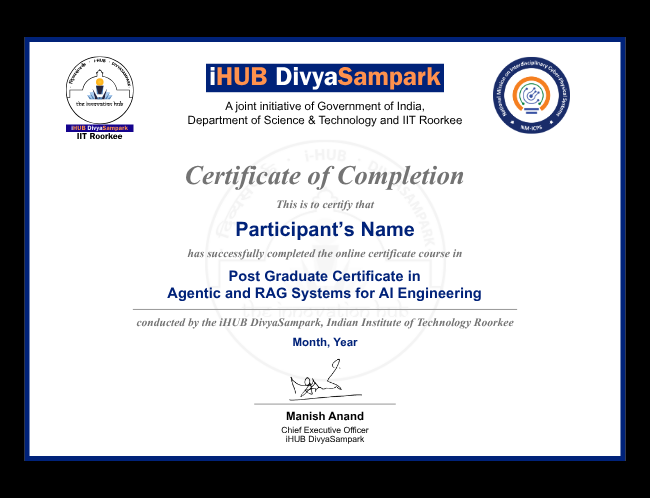
Certificate Awarded Post Completion of iHUB, DivyaSampark, IIT Roorkee Agentic and RAG Systems Programme
Participants who successfully complete all graded mini projects, achieve a minimum overall score of 50%, secure at least 50% in the Capstone Project, and maintain a minimum attendance of 50% throughout the programme will be awarded the Certificate of Completion.
Note:
Sample certificate is indicative. The Institute reserves the right to revise it.
Emeritus Career Services
Alongside developing expertise in Agentic AI and RAG systems, learners gain access to career resources that support professional growth. These recorded sessions focus on helping you showcase your skills, strengthen your online presence, and prepare for future opportunities.
15 Recorded Sessions and Resources in the Following Categories (Please note: These sessions are not live):
Resume & Cover
Letter Navigating
Job Search Interview Preparation
LinkedIn Profile Optimisation
Note:
This service is available only for Indian residents enrolled in select Emeritus programmes.
iHub DivyaSampark, IIT Roorkee or Emeritus do NOT promise or guarantee a job or progression in your current job. Career Services is only offered as a service that empowers you to manage your career proactively. The Career Services mentioned here are offered by Emeritus. IIT Roorkee is NOT involved in any way and makes no commitments regarding the Career Services mentioned here
Frequently Asked Questions about the Agentic AI and RAG Systems Programme
What is iHub DivyaSampark, IIT Roorkee?
iHUB DivyaSampark aims to enable innovative ecosystems in new-age technologies such as AI, ML, Drones, Robotics and Data Analytics—key areas within Cyber-Physical Systems (CPS). It works towards building the next generation of digital technologies, products and services through capacity building, manpower training, innovation and technology development, contributing to national strategic sectors and the Digital India vision. iHUB DivyaSampark, a Section 8 company (Non-Government Organisation), is a Technology Innovation Hub at IIT Roorkee established under the National Mission on Interdisciplinary Cyber-Physical Systems (NM-ICPS), initiated by the Department of Science & Technology (DST), Government of India. The Hub works towards fostering innovation, developing technology solutions, building skilled manpower and encouraging entrepreneurship to address emerging challenges across areas such as healthcare, Industry 4.0, smart cities and defence. Through its training and capacity-building initiatives, iHUB DivyaSampark focuses on equipping learners and professionals with skills in emerging technologies. These initiatives are designed to foster innovation, critical thinking, adaptability and practical capabilities, enabling participants to contribute meaningfully to the evolving technology and digital ecosystem.
Is the iHub DivyaSampark, IIT Roorkee certificate recognised by employers?
The Certificate of Completion is issued by iHub DivyaSampark, IIT Roorkee, a Government of India initiative under the Department of Science and Technology. It carries the institutional credibility of IIT Roorkee, one of India's oldest and most reputed technical universities, and the government backing of the NM-ICPS mission. For technology employers evaluating candidates in AI engineering and software engineering, the combination of the IIT Roorkee name and the practical, production-focused curriculum rather than theoretical coursework makes the credential meaningful. The certificate validates demonstrated skills across RAG systems, agentic AI, fine-tuning, and deployment, not just course attendance.
What are the eligibility criteria for the Post Graduate Certificate in Agentic and RAG Systems for AI Engineering?
To be eligible for the Post Graduate Certificate in Agentic and RAG Systems for AI Engineering, applicants should hold a bachelor's degree or higher. Diploma holders with a minimum of three years of professional work experience are also eligible to apply. In addition, intermediate familiarity with programming concepts is expected through prior coding experience.
Who is the Post Graduate Certificate in Agentic and RAG Systems for AI Engineering designed for?
The Post Graduate Certificate in Agentic and RAG Systems for AI Engineering is designed for two primary audiences. The first is software engineers, data professionals, and AI practitioners who build software professionally, have worked with APIs and codebases, and want to develop the ability to build production-grade AI systems not just use AI tools. The second is tech leads, architects, and product managers who make technology decisions, have prior exposure to software or AI projects, and want the technical depth to evaluate AI proposals, guide implementation, and drive adoption confidently. Both audiences benefit from the programme's practical, AI engineering-first structure.
How much time should I dedicate each week to the Post Graduate Certificate in Agentic and RAG Systems for AI Engineering?
Participants in the Post Graduate Certificate in Agentic and RAG Systems for AI Engineering should expect to spend approximately 8 to 10 hours per week on programme activities. This includes attendance at two live sessions per week, each three hours long, plus time for assignments, hands-on labs, and project work. The programme is specifically designed to be compatible with a full-time working schedule. No career break is needed to complete this agentic AI course in India; it has been built for professionals who are learning while continuing to work.
What programming knowledge is required before joining the Post Graduate Certificate in Agentic and RAG Systems for AI Engineering?
Participants joining the Post Graduate Certificate in Agentic and RAG Systems for AI Engineering are expected to have an intermediate understanding of programming concepts. The programme begins with a dedicated Python for AI Engineering module to bring all participants to a consistent baseline in production-oriented Python covering async programming, API handling, Pydantic validation, and pipeline-oriented coding. The programme is not designed for complete beginners to programming but does not require prior deep software engineering expertise. This makes it accessible to professionals looking for structured agentic AI engineering training in India.
Is this a retrieval augmented generation course available in India?
Yes. The Post Graduate Certificate in Agentic and RAG Systems for AI Engineering from iHUB DivyaSampark, IIT Roorkee is a structured retrieval augmented generation course in India and a comprehensive RAG systems course built around production engineering. The programme dedicates two full modules to RAG architecture and production RAG optimisation, covering hybrid retrieval, reranking, HyDE, semantic caching, evaluation using RAGAS and DeepEval, and RAG failure analysis. Participants build end-to-end RAG pipelines across multiple hands-on projects, culminating in a production-grade RAG system as part of the capstone. It is a RAG certification course in India backed by iHUB DivyaSampark, a Government of India initiative.
Is this a production AI engineering course or a conceptual programme?
This is a production AI engineering course. Every module in the programme connects directly to a real engineering task and every pillar builds toward a deployed system. Participants do not just learn concepts — they build RAG pipelines, autonomous agents, and fine-tuned models that are deployed, monitored, and evaluated against production benchmarks. The capstone requires participants to ship a complete AI system with a live API endpoint, a real-time monitoring dashboard, and a GitHub repository. It is built for technology professionals who want to build and operate production-ready AI systems, not just understand them in theory.
How do I become an AI engineer in India with Agentic AI and RAG skills?
Becoming an AI engineer in India with production-grade Agentic AI and RAG skills requires moving beyond tutorials and demos to building systems that hold up under real conditions. The iHUB DivyaSampark Agentic AI and RAG Systems programme is designed exactly for this transition. Over 6 months, 100% live online, you build RAG pipelines, autonomous agents, fine-tuned models, and deployed AI systems. You graduate with a GitHub repository, a live API endpoint, and a monitoring dashboard — the kind of proof of work that employers in India and globally are looking for
What hands-on experience will I gain during the Post Graduate Certificate in Agentic and RAG Systems for AI Engineering?
During the Post Graduate Certificate in Agentic and RAG Systems for AI Engineering, participants will complete six module-end projects, each tied to a specific pillar of the curriculum, plus a final capstone project. The module projects cover prompt evaluation, RAG pipeline construction, production RAG optimisation with hybrid retrieval and reranking, LLM fine-tuning with QLoRA, tool-calling agent development, and MCP-based AI integration with security guardrails. The capstone requires participants to build, deploy, and monitor a full production AI system integrating RAG, an autonomous agent, a fine-tuned model, and a live observability dashboard. All projects are designed to mirror real AI engineering tasks, not tutorial exercises.
What certificate will I receive upon completing the Post Graduate Certificate in Agentic and RAG Systems for AI Engineering?
Upon completing the Post Graduate Certificate in Agentic and RAG Systems for AI Engineering, participants who meet all completion requirements will receive a Certificate of Completion from iHUB DivyaSampark, IIT Roorkee. The certificate is issued by iHub DivyaSampark, a Government of India initiative, and carries the IIT Roorkee institutional identity. To receive the AI engineering certificate, participants must complete all graded mini projects with a minimum overall score of 50%, achieve at least 50% in the capstone project, and maintain a minimum of 50% attendance throughout the programme. The certificate is awarded as an e-certificate upon successful completion.
What tools and technologies will I learn in the Post Graduate Certificate in Agentic and RAG Systems for AI Engineering?
The Post Graduate Certificate in Agentic and RAG Systems for AI Engineering provides hands-on exposure to 15+ industry-standard tools across the full AI engineering lifecycle. For RAG and retrieval, participants work with Qdrant, FAISS, Chroma, and OpenAI embeddings. For agentic AI, the programme covers LangGraph, CrewAI, and Smolagents. For LLM fine-tuning, participants use Hugging Face, Unsloth, and Axolotl. AI deployment and observability tools include FastAPI, GitHub Actions, and Langfuse. Security and governance modules cover Guardrails AI and NeMo Guardrails. The programme also includes Model Context Protocol (MCP) integration, a skill most comparable programmes do not cover. Every tool is taught in the context of a real engineering task, giving participants hands-on experience across the full stack of production AI systems engineering in India and globally."
What is the capstone project in the Post Graduate Certificate in Agentic and RAG Systems for AI Engineering?
The capstone project in the Post Graduate Certificate in Agentic and RAG Systems for AI Engineering requires participants to design, build, and deploy a production-ready AI application that integrates the core technical capabilities covered throughout the programme. Specifically, participants build a production-grade RAG pipeline with hybrid search and reranking, a LangGraph-orchestrated agent with tool-calling and failure handling, a FastAPI deployment for scalable API serving, and a Langfuse monitoring dashboard tracking latency, cost, and answer quality. The final deliverables include a GitHub repository with the complete system, a deployed API endpoint, a real-time monitoring dashboard, and a demo-ready walkthrough.
Is there an opportunity to visit the IIT Roorkee campus during the Post Graduate Certificate in Agentic and RAG Systems for AI Engineering?
Yes. Participants enrolled in the Post Graduate Certificate in Agentic and RAG Systems for AI Engineering have access to an optional two-day on-campus immersion experience at IIT Roorkee's Noida campus. This optional experience is designed to provide a sense of connection to the iHUB, IIT Roorkee ecosystem beyond the online AI engineering programme environment.
What is the refund policy for the Post Graduate Certificate in Agentic and RAG Systems for AI Engineering?
For the Post Graduate Certificate in Agentic and RAG Systems for AI Engineering, refund requests may be initiated before the commencement of the programme. Once the agentic and RAG systems certification programme begins on 23 September 2026, the programme fee becomes non-refundable. Participants are advised to review the full terms and conditions before making a payment.
Elevate your career with this programme!
Flexible payment options available.
Starts On