
Post Graduate Certificate in Agentic Systems & Production AI
Avail Early Enrolment Benefit of Invalid liquid databefore Invalid liquid data
Invalid liquid data / AED 53 (Applicable Taxes will be charged at checkout)
What Sets This Production AI Programme Apart

What Is the Post Graduate Certificate in Agentic Systems & Production AI?
The Post Graduate Certificate in Agentic Systems & Production AI by iHUB DivyaSampark, IIT Roorkee is a six-month, live online programme designed to help professionals take AI systems from development to enterprise production. Participants learn to build automated pipelines and scalable environments, and manage models, LLMs, retrieval systems and AI agents in production. The programme also addresses reliability, cost control, security and governance across the AI lifecycle.
Programme Snapshot
Duration: 6 Months
Mode: Live Online
Programme Fee: INR 1,50,000 + Applicable GST
Certificate: e-Certificate from iHUB DivyaSampark, IIT Roorkee upon successful completion
Campus Immersion: Optional two-day experience at IIT Roorkee’s Noida campus upon programme completion
Why Do Enterprises Struggle to Take AI from Pilot to Production?
88%
62%
Only 1%
What Are the Key Highlights of the Post Graduate Certificate in Agentic Systems & Production AI?

Full Production AI Stack in One Programme
Build capabilities across MLOps, LLMOps, AgentOps, RAGOps, cloud-native infrastructure, AI security and governance.
Six-Month Structured Learning Journey
Progress from AI, DevOps and cloud foundations to enterprise AI infrastructure, LLMOps, agentic systems, security and governance.

Live Online Weekend Sessions
Attend three-hour live online sessions on Saturdays and Sundays, led by domain experts.

Live IIT Faculty Masterclasses
Gain valuable perspectives through live online IIT faculty-led masterclasses.

25+ Tools and Platforms
Gain practical exposure to tools used across AI infrastructure, deployment, orchestration, monitoring and governance.

Virtual Labs
Apply Production AI concepts and practise programme workflows in virtual lab environments.

Hands on Projects and an Enterprise Capstone
Apply programme concepts through six graded mini-projects and integrate your learning through an Enterprise ModelOps and LLM Infrastructure Capstone.

Optional Campus Immersion
Participate in an optional two-day immersion at IIT Roorkee’s Noida campus upon programme completion.

Certificate from iHUB DivyaSampark, IIT Roorkee
Earn an e-Certificate from iHUB DivyaSampark, IIT Roorkee upon successfully meeting the programme completion requirements.
Notes:
The programme highlights presented above are approximate, and subject to change depending on the availability and expertise of the teaching faculty, as well as the programme's desired outcomes.
This programme summary is provided only for your convenience. You are advised to refer to the programme brochure for more information.
Programmed leader is the domain expert responsible for conducting weekly live sessions.
The primary mode of learning for this programme is via live online sessions with industry experts. Post session video recordings will be made available, at the discretion of faculty members.
IIT faculty masterclasses will be conducted on weekdays. The programme includes approximately 12 hours of live online masterclasses by IIT faculty, offering participants expert perspectives and insights on relevant concepts, emerging technologies and practical applications. The schedule for faculty masterclasses will be shared post programme orientation.
Who Is the Post Graduate Certificate in Agentic Systems & Production AI For?
The Post Graduate Certificate in Agentic Systems & Production AI is designed for technology professionals who want to develop the skills to deploy, scale, monitor and manage AI systems in enterprise production environments.
Cloud, DevOps and Platform Professionals: DevOps Engineers, Cloud Engineers, Site Reliability Engineers, Platform Engineers and Backend Engineers who want to expand their capabilities across containerised AI deployment, Kubernetes, infrastructure as code and scalable AI infrastructure.
Software and Backend Engineering Professionals: Software Engineers, Backend Engineers, Full Stack Engineers and Senior Software Engineers who want to extend their programming, API, database and microservices experience towards enterprise LLM integration, RAG systems, agentic architectures and Production AI deployment.
AI, ML and Data Professionals: ML Engineers, AI Engineers, Data Engineers, Data Scientists and MLOps Professionals who want to develop practical capabilities across production ML pipelines, model serving, experiment tracking, drift monitoring and model lifecycle management.
AI Architects, Tech Leads and Engineering Leaders: Solution Architects, Enterprise Architects, Tech Leads, Engineering Managers, Development Managers, AI Engineering Leads, AI Practice Leads and Platform Leaders who want to strengthen their capabilities across Production AI infrastructure, LLM and agentic systems, cost management, reliability, security and governance.
Minimum Eligibility: Applicants must hold a bachelor’s degree or diploma with min. 3 years of work experience. Intermediate proficiency in Python and basic knowledge of cloud infrastructure and DevOps practices is required.
What Will You Be Able to Do After the Post Graduate Certificate in Agentic Systems & Production AI?

Build In-Demand AI Skills
Professionals with AI skills earn an average 56% wage premium compared to peers in similar roles. As enterprises scale AI, professionals who can deploy, secure and manage AI systems are increasingly valuable.
Source: PwC, Global AI Jobs Barometer, 2025

Navigate the Production AI Landscape
Connect MLOps, LLMOps, AgentOps and RAGOps across the AI lifecycle.

Build Cloud-Native AI Infrastructure
Create CI/CD pipelines, provision reproducible environments with Terraform, and deploy autoscaling AI workloads on Kubernetes.

Automate Production ML Pipelines
Orchestrate pipelines with data validation and feature integration, continuous training, deployment gates and rollback.

Manage the Enterprise Model Lifecycle
Track experiments, version data and models, and manage approvals, lineage and audit trails through model registries.

Deploy and Monitor Production Models
Serve models as performance-tested APIs, detect drift, trigger retraining, and manage defined SLAs and SLOs.

Manage Enterprise LLMs, RAG Systems and AI Agents
Optimise LLM serving and costs, manage vector and retrieval infrastructure, and deploy observable, governed AI agent services.

Secure and Govern Enterprise AI Systems
Apply access controls, audit logging, data privacy and compliance practices across Production AI environments.
What Does the Post Graduate Certificate in Agentic Systems & Production AI Curriculum Cover?
Pillar 1: AI ML Foundations
Module 1: AI ML Refresher for Production
Python Refresher, ML Fundamentals Recap
Supervised Vs Unsupervised Learning
Evaluation Metrics (Classification & Regression)
Bias-Variance In Production
Dataset Shift Basics
Intro To DL & LLM System Boundaries (Conceptual Positioning Only)
Skills Acquired: Python for production | ML fundamentals recap | Evaluation metrics | Bias-variance & dataset shift | LLM system boundaries
Learning Outcome: Apply ML fundamentals, evaluation metrics and dataset shift concepts as a shared basis for the modules that follow.
Pillar 2: AI Infrastructure & Platform Engineering
Module 2: DevOps & Cloud Foundations for AI
Devops Philosophy
CI/CD Pipeline
Git Workflows
Linux CLI Essentials
Cloud Service Models (AWS/Azure/GCP)
Cloud Security Basics
Cost Awareness
Integrating ML Lifecycle Into CI/CD
Skills Acquired: DevOps philosophy | CI/CD pipelines | Git workflows | Linux CLI | AWS, Azure & GCP service models | Cloud security & cost basics
Learning Outcome: Understand CI/CD, Git workflows, Linux CLI and cloud service models, and how the ML lifecycle fits into them.
Module 3: Containerization & Orchestration For AI
Docker Architecture
Dockerfiles
Container Networking
Kubernetes Core Concepts (Pods, Services, Deployments)
Autoscaling (HPA)
GPU Scheduling Fundamentals For Inference Workloads
Scaling ML Services
Skills Acquired: Docker & Dockerfiles | Container networking | Kubernetes Pods, Services, Deployments | HPA autoscaling | GPU scheduling for inference
Learning Outcome: Containerize an ML service and deploy it to Kubernetes with autoscaling and GPU-aware scheduling.
Module 4: Infrastructure as Code & Environment Automation
IaC Principles
Terraform Fundamentals
Environment Reproducibility
Secrets Management
Infrastructure Versioning
Provisioning ML-Ready Environments
Advanced Terraform Modules & Workspaces
Hybrid IaC + Kubernetes Integration
Policy-as-Code & Compliance Automation
Disaster Recovery & Scaling Automation
Skills Acquired: IaC principles | Terraform modules & workspaces | Secrets management | IaC + Kubernetes | Policy-as-code | DR & scaling automation
Learning Outcome: Provision reproducible ML environments with Terraform, applying secrets management, policy-as-code and recovery planning.
Pillar 3: ML Engineering & MLOps
Module 5: ML Lifecycle & Pipeline Automation
ML System Architecture
Data Ingestion & Validation
Feature Engineering Pipelines
Feature Store Integration
DAG Design
Pipeline Orchestration Patterns
Automation Checkpoints Before Deployment
Reliable ML Pipeline Deployment
Skills Acquired: ML system architecture | Data ingestion & validation | Feature pipelines & feature store | DAG design | Orchestration patterns
Learning Outcome: Design an ML pipeline covering ingestion, validation, feature engineering and orchestration with pre-deployment checkpoints.
Module 6: Experiment Tracking & Reproducibility
Experiment Tracking Principles
Hyperparameter Logging
Artifact Tracking
Data & Model Versioning
Reproducibility Workflows
Governance Checkpoints In Experimentation
Skills Acquired: Experiment tracking | Hyperparameter & artifact logging | Data & model versioning | Reproducibility workflows | Governance checkpoints
Learning Outcome: Track experiments, artifacts and data/model versions so past results can be reproduced and reviewed.
Module 7: Model Packaging & Deployment
Model Serialization (Pickle, ONNX)
REST API Design For ML
Batch Vs Real-Time Inference
API Performance Testing
Inference Latency Considerations
Deployment Patterns (Containerized Serving), Scalability with Tools
Skills Acquired: Model serialization (Pickle, ONNX) | REST API design for ML | Batch vs real-time inference | API performance testing | Containerized serving
Learning Outcome: Package a model and expose it through a tested inference API, choosing between batch and real-time serving.
Module 8: CI/CD for ML Systems
Continuous Training Pipelines
Automated Validation Gates
Model Approval Workflows
Trigger-Based Deployment
Rollback Strategies
Integration With Orchestration Pipelines
Skills Acquired: Continuous training | Automated validation gates | Model approval workflows | Trigger-based deployment | Rollback strategies
Learning Outcome: Set up continuous training with automated validation gates, approval workflows and rollback paths.
Module 9: Monitoring, Drift & Governance
Model Performance Monitoring
Data Drift & Concept Drift Detection
A/B Testing Strategies
Retraining Triggers
Governance Dashboards
Interpreting Monitoring Metrics For Business Decisions
Skills Acquired: Performance monitoring | Data & concept drift detection | A/B testing | Retraining triggers | Governance dashboards
Learning Outcome: Monitor model performance, detect data and concept drift, and define retraining triggers and governance reporting.
Pillar 4: Enterprise AI Platforms & Agentic Systems
Module 10: Model Registry & Enterprise Lifecycle
Model Registry Design
Approval Workflows
Artifact Lineage
Audit Trails
Compliance Tracking
Enterprise AI Lifecycle Management
Skills Acquired: Model registry design | Approval workflows | Artifact lineage | Audit trails | Compliance tracking | Enterprise AI lifecycle
Learning Outcome: Use a model registry to manage approvals, artifact lineage and audit trails across the model lifecycle.
Module 11: Enterprise LLM Hosting & Optimization
LLM Serving Architectures (Managed APIs Vs Self-Hosted)
Inference Optimization Basics
VLLM Fundamentals
Quantization Concepts (INT8/4-Bit Overview)
GPU Utilization
Throughput Benchmarking
Latency Vs Cost Trade-Offs
Production LLM Deployment Patterns
Skills Acquired: Managed vs self-hosted LLM serving | vLLM | Quantization (INT8/4-bit) | GPU utilization | Throughput benchmarking | Latency vs cost
Learning Outcome: Compare managed and self-hosted LLM serving, and benchmark throughput, latency and cost trade-offs.
Module 12: AI Agent Architecture & Foundations
Fundamentals ofAI Agents and Architectures
Agent Runtime Hosting, Service Isolation, Concurrency
Docker/Kubernetes-Based Deployment, Observability, Audit Logging
Operational Safety Controls
Security and Compliance
Resource Allocation and Infrastructure-Level Scaling of Enterprise Agent-Based Systems.
Skills Acquired: Agent architectures | Agent runtime hosting | Service isolation & concurrency | Docker/Kubernetes agent deployment | Observability & audit logging | Safety controls
Learning Outcome: Deploy agent runtimes on Docker and Kubernetes with service isolation, observability, audit logging and safety controls.
Module 13: Enterprise AI Hosting Strategies
Advanced Inference Optimization
Distributed LLM Serving
Prompt Caching Strategies
Enterprise-Grade APIs For Scalable
High-Performance and Cost-Efficient Production Deployments.
Skills Acquired: Advanced inference optimization | Distributed LLM serving | Prompt caching | Enterprise-grade APIs | Cost-efficient deployment
Learning Outcome: Apply inference optimization, distributed serving and prompt caching to improve LLM performance and cost efficiency.
Pillar 5: Enterprise LLMOps, RAG Ops & AI Security
Module 14: LLM Cost Engineering & Secure Deployment
Token Cost Modeling
Caching Strategies
Rate Limiting
API Gateways
Access Control
Secure Model Endpoints
Cost-Performance Dashboards
Enterprise Proxy Patterns For LLM Usage, SLA/SLO Modeling
Cost-Performance Trade-Offs
High Availability Architectures
Multi-Region Deployment Concepts
Disaster Recovery Strategies
Architecture Case Studies For ML & LLM Systems
Skills Acquired: Token cost modeling | Caching & rate limiting | API gateways & access control | Secure endpoints | SLA/SLO modeling | Multi-region HA & DR
Learning Outcome: Model token costs and secure LLM endpoints, and plan for SLAs/SLOs, high availability and disaster recovery.
Module 15: Vector Infrastructure & Retrieval Infrastructure
Vector Database Architecture
Indexing Strategies
Sharding & Scaling
Embedding Lifecycle Management
Embedding Drift Detection
Storage Tiering (Hot Vs Cold)
Operational Considerations For Large-Scale Vector Systems
Skills Acquired: Vector DB architecture | Indexing strategies | Sharding & scaling | Embedding lifecycle | Embedding drift detection | Hot vs cold storage tiering
Learning Outcome: Select vector indexing, sharding and storage tiering approaches, and manage the embedding lifecycle and drift.
Module 16: RAG Ops
Fundamentals of RAG
Vector Databases and Indexing
Secure Retrieval Workflows
Monitoring and Observability
RAG Governance
RAGOps Integration
Vector Database Governance
Production-Ready RAG Case Studies
Skills Acquired: RAG fundamentals | Vector databases & indexing | Secure retrieval workflows | Monitoring & observability | RAG & vector DB governance | RAGOps integration
Learning Outcome: Build and operate a RAG pipeline with secure retrieval, monitoring and governance controls.
Module 17: AI Security & Compliance
AI System Security and Robustness
Compliance Frameworks
Audit Logging
Data Privacy for Secure, Compliant, and Resilient Enterprise AI Systems.
Enterprise AI Systems Against Adversarial Threats While Ensuring Strict Alignment with Global Compliance Frameworks.
Secure Deployment
Audit Governance
Privacy‑Preserving Practices
Skills Acquired: AI system security & robustness | Adversarial threat defense | Compliance frameworks | Audit logging | Data privacy & privacy-preserving practices
Learning Outcome: Apply AI security, audit logging and data privacy practices aligned to compliance frameworks.
Capstone: End-To-End Enterprise ModelOps and LLM Infrastructure Capstone
Integrating CI/CD Automation
Model Registry
Monitoring
Drift Detection
Serving Optimization
Cost Governance
Architecture Documentation
Enterprise Deployment Review
Skills Acquired: CI/CD automation | Model registry | Monitoring & drift detection | Serving optimization | Cost governance | Architecture documentation | Deployment review
Learning Outcome: Deliver an integrated ModelOps and LLM infrastructure project with architecture documentation and a deployment review.
Note:
Modules/ topics are indicative only, and the suggested time and sequence may be dropped/ modified/ adapted to fit the participant profile & programme hours.
The primary mode of learning for this programme is via live online sessions led by industry experts and live masterclasses led by IIT faculty. Post session video recordings will be made available, at the discretion of faculty members.
Which Tools and Platforms Are Covered in the Post Graduate Certificate in Agentic Systems & Production AI?

Note:
This section highlights only a selection of tools from a more extensive list available.
All product and organisation names are trademarks or registered trademarks of their respective holders, and their use does not imply any affiliation with or endorsement by them.
All programme curriculum - topics, modules, submodules, tools - stated here is subject to change as per the discretion iHUB DivyaSampark, IIT Roorkee or Emeritus
Tool subscriptions are not provided by Emeritus.
Some tools may require local installation. If you are using a company-issued laptop, please ensure you have permission to install applications. A personal laptop is recommended if your office device has restrictions on software installation, browser extensions, file access, or AI/development tools.
Most of the programme activities will be completed using the free versions of the tools provided in the virtual lab.
IIT Faculty for Masterclasses

Dr. Gaurav Bhatnagar
Professor, Department of Mathematics, Indian Institute of Technology Jodhpur
Dr. Gaurav Bhatnagar has been a Professor in the Department of Mathematics at the Indian Institute of Technology Jodhpur since June 2023, having previously served as Assistant...
Note:
Programme faculty might change due to unavoidable circumstances, and revised details will be provided closer to programme start date.
Only live masterclasses will delivered by IIT faculty and the weekly live sessions will be conducted by industry experts.
The programme includes approximately 12 hours of live online masterclasses by IIT faculty, offering participants expert perspectives and insights on relevant concepts, emerging technologies and practical applications. The schedule for faculty masterclass will be shared post programme orientation.
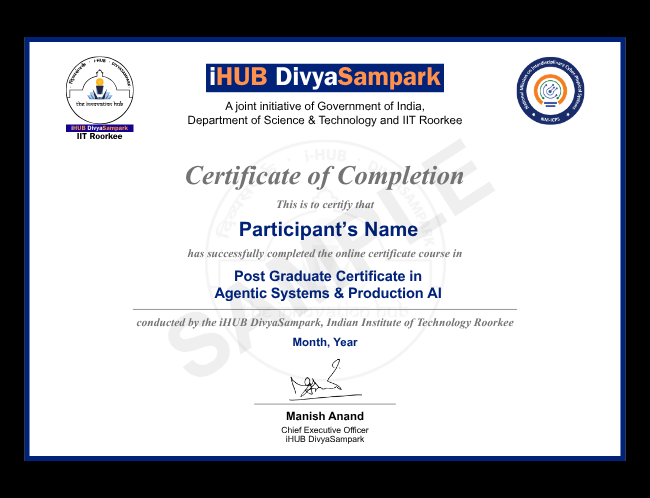
What Certificate Will Participants Receive After Completing the Programme?
Participants who successfully complete the Post Graduate Certificate in Agentic Systems & Production AI will receive an e-Certificate from iHUB DivyaSampark, IIT Roorkee.
To qualify for the certificate, participants must complete all graded mini-projects and assignments with a minimum overall score of 50% and maintain at least 50% attendance in live sessions throughout the programme.
Note:
All certificate images are for illustrative purposes only and may be subject to change at the discretion of iHUB DivyaSampark, IIT Roorkee
We encourage you to attend all the live sessions and make the best out of these interactive learning experiences. Post-session video recordings will be made available, at the discretion of faculty member.
How Does the Post Graduate Certificate in Agentic Systems & Production AI Compare with Other AI Programmes?
Comparison Area | This Production AI Programme | Other AI and MLOps Programmes |
Programme Scope | Integrated coverage of MLOps, LLMOps, AgentOps and RAGOps | Often centred on model development, MLOps or GenAI application building |
Infrastructure Depth | Terraform, containers, Kubernetes, GPU scheduling, high availability and disaster recovery | Typically focused on CI/CD, containerisation and model deployment |
LLM Operations | LLM hosting, vLLM, quantisation, benchmarking, prompt caching and cost engineering | Often focused on LLM usage and application development |
Agentic Systems | Agent runtime hosting, service isolation, observability, audit logging and operational controls | Commonly focused on agent design and orchestration |
RAG Operations | Vector infrastructure, indexing, sharding, embedding lifecycle, monitoring and governance | Commonly focused on building RAG applications |
Security and Governance | Access control, audit trails, privacy, compliance and AI security integrated across the lifecycle | Often addressed through model governance or application-level guardrails |
Applied Learning | Virtual labs, graded mini-projects and an Enterprise ModelOps and LLM Infrastructure Capstone | Often culminates in a model deployment, GenAI application or agent prototype |
Frequently Asked Questions About the iHUB, IIT Roorkee's Agentic Systems & Production AI Programme?
What is the Post Graduate Certificate in Agentic Systems & Production AI?
The Post Graduate Certificate in Agentic Systems & Production AI is a six-month, live online programme by iHUB DivyaSampark, IIT Roorkee. It is designed to help technology professionals develop capabilities across MLOps, LLMOps, AgentOps, RAGOps and cloud-native AI infrastructure.
Who is the Post Graduate Certificate in Agentic Systems & Production AI for?
This Production AI course is designed for software and backend engineers, DevOps and cloud professionals, platform engineers, Site Reliability Engineers, AI and ML professionals, data professionals, solution architects, tech leads and engineering managers who want to develop capabilities for taking AI systems into enterprise production.
What are the eligibility criteria and prerequisites for the Agentic Systems & Production AI Programme?
Applicants must hold a bachelor’s degree or diploma and have at least three years of work experience. Participants should also have:
Intermediate proficiency in Python
Basic knowledge of cloud infrastructure
Basic knowledge of DevOps practices
What Does the Production AI Course Curriculum Cover?
The Production AI course curriculum covers the systems and practices required to manage models, LLMs, RAG systems and AI agents in production. The 24-week curriculum spans AI and ML foundations, DevOps and cloud foundations, Docker, Kubernetes, infrastructure as code, production ML pipelines, MLOps, experiment tracking, model registries, model deployment, monitoring and drift detection. It also covers enterprise LLM hosting and optimisation, agentic systems, agent runtime deployment, vector infrastructure, RAGOps, AI security, governance and compliance, culminating in an Enterprise ModelOps and LLM Infrastructure Capstone.
How is this Production AI programme different from a traditional MLOps course?
This Production AI programme extends beyond traditional MLOps by covering the production requirements of ML models, LLMs, RAG systems and AI agents.In addition to ML pipelines, deployment and model monitoring, participants explore LLM hosting and cost engineering, vector infrastructure, RAGOps, agent runtime deployment, observability, security and governance.
Does this Agentic Systems & Production AI programme cover LLMOps, AgentOps and RAGOps?
Yes. This programme includes dedicated coverage of LLMOps, AgentOps and RAGOps, alongside MLOps and cloud-native AI infrastructure.Participants explore:
LLMOps: LLM hosting, vLLM, quantisation, benchmarking, prompt caching and cost management
AgentOps: Agent runtime hosting, service isolation, concurrency, observability and audit logging
RAGOps: Vector infrastructure, indexing, retrieval workflows, monitoring and governance
Does this production AI programme cover enterprise AI infrastructure engineering?
Yes. The programme covers enterprise AI infrastructure engineering across containers, orchestration, infrastructure automation, scalable serving and reliability.Participants learn about Docker, Kubernetes, Terraform, GPU-aware scheduling, autoscaling, high availability and disaster recovery concepts for Production AI environments.
Which tools and platforms are covered in the Agentic Systems & Production AI programme?
Participants gain practical exposure to 25+ tools and platforms used across AI infrastructure, MLOps, LLMOps, RAGOps, monitoring and agentic systems. The indicative toolset includes AWS, Docker, Kubernetes, Terraform, Apache Airflow, MLflow, FastAPI, ONNX Runtime, KServe, vLLM, Hugging Face, LangGraph, Prometheus, Grafana and Evidently AI.
What is the duration, fee, certificate and completion requirements of the Post Graduate Certificate in Agentic Systems & Production AI?
The programme runs for six months, is delivered live online, and requires approximately 8–10 hours of weekly effort. The programme fee is INR 1,50,000 plus applicable GST.
Participants who successfully meet the completion requirements will receive an e-Certificate from iHUB DivyaSampark, IIT Roorkee. Participants must maintain at least 50% attendance in live sessions and achieve a minimum overall score of 50% across the required assessments.
An optional two-day campus immersion at IIT Roorkee’s Noida campus is available upon programme completion.
Elevate your career with this programme!
Flexible payment options available.
Starts On