Post Graduate Certificate in Intelligent Automation and Workflows with AI Agents
Avail Early Enrolment Benefit of Invalid liquid databefore Invalid liquid data
Invalid liquid data / AED 53 (Applicable Taxes will be charged at checkout)
The Intelligent Automation Learning Experience

Why Are Enterprises Moving to Intelligent Automation and Agentic Workflows?
AI agents add task-level reasoning and autonomy. They interpret information, use tools and perform actions within defined objectives and permissions. Multiple agents can coordinate across enterprise processes, with human approvals and governance controls incorporated where required.
By bringing together AI-powered decisions, coordinated agents, enterprise systems and human oversight, intelligent automation helps organisations move beyond isolated bots and fragmented processes. The challenge is not only building AI agents, but integrating and governing them for reliable and secure enterprise workflows.
45%
55%
40%
What Is the Post Graduate Certificate in Intelligent Automation and Workflows with AI Agents
The Post Graduate Certificate in Intelligent Automation and Workflows with AI Agents by iHUB DivyaSampark, IIT Roorkee is a 20-week, live online programme that helps professionals build enterprise-grade intelligent automation systems using Enterprise LLMs, Agentic AI, Multi-Agent Systems, workflow orchestration and decision automation.
Priced at INR 1,09,000 + GST, the Intelligent Automation and Workflows with AI Agents programme provides a practical pathway to designing, integrating and governing intelligent automation for enterprise workflows. Participants learn to architect adaptive workflows, build agentic and multi-agent systems, integrate AI with enterprise applications through APIs and event-driven architectures, and apply governance, security, reliability and human oversight throughout the system design process.
Key Highlights of the Post Graduate Certificate in Intelligent Automation and Workflows with AI Agents

20 Week Structured Journey
Progress from Python for automation and AI/ML foundations to Enterprise LLMs, Agentic AI, Multi-Agent Systems, integration, governance and security.

Live Online Weekend Sessions led by Industry Experts
Attend expert-led 3-hour live online sessions every Saturday and Sunday

12 Hands-On Projects
Apply concepts through projects spanning automation, AI agents, integration, governance and security.

10+ Tools and Platforms
Gain hands-on exposure to tools used to build automated workflows, orchestrate LLMs and apply governance controls.

Live IIT Faculty Masterclasses
Gain valuable perspectives through live online IIT faculty-led masterclasses.

Enterprise-Focused Capstone Project
Build an end-to-end automation with multi-agent workflows, enterprise integrations and governance controls.

Campus Immersion
Participate in an optional 2-day campus immersion at IIT Roorkee’s Noida Campus upon successful programme completion.

Certificate from iHUB, IIT Roorkee
Earn a Post Graduate Certificate in Intelligent Automation and Workflows with AI Agents issued by iHUB DivyaSampark, IIT Roorkee upon successfully completion
Notes:
The programme highlights presented above are approximate, and subject to change depending on the availability and expertise of the teaching faculty, as well as the programme's desired outcomes.
This programme summary is provided only for your convenience. You are advised to refer to the programme brochure for more information.
Programmed leader is the domain expert responsible for conducting weekly live sessions.
The primary mode of learning for this programme is via live online sessions with industry experts. Post session video recordings will be made available, at the discretion of faculty members.
IIT faculty masterclasses will be conducted on weekdays. The programme includes approximately 10 hours of live online masterclasses by IIT faculty, offering participants expert perspectives and insights on relevant concepts, emerging technologies and practical applications. The schedule for faculty masterclasses will be shared post programme orientation.
iHUB DivyaSampark, IIT Roorkee or Emeritus do NOT promise or guarantee a job or progression in your current job.
Who Should Enrol in the Intelligent Automation and Workflows with AI Agents Programme by iHUB, IIT Roorkee ?
The Post Graduate Certificate in Intelligent Automation and Workflows with AI Agents is a structured 5-month journey designed for professionals who want to move beyond rule-based automation and standalone AI agents to build integrated, reliable and governed workflows for enterprise use.
Software, Automation and Process Excellence Professionals: Software developers, RPA professionals, workflow and process automation engineers, integration developers, data professionals and process excellence practitioners looking to build adaptive workflows using Enterprise LLMs, AI agents and Multi-Agent Systems.
AI, Data and Integration Professionals: AI/ML practitioners, data engineers, integration developers and enterprise application professionals looking to integrate AI workflows with enterprise systems, APIs and event-driven architectures while designing for reliability, security and governance.
Technology and Solution Consultants: Technology and solution consultants involved in evaluating, designing or implementing enterprise automation solutions who want to assess automation architectures, design intelligent workflows and support enterprise AI implementation.
Minimum Eligibility: Bachelor's degree or higher, or diploma holders with a minimum of 3 years of work experience. Basic familiarity with programming concepts is recommended.
What Will You Be Able to Do After Completing the Intelligent Automation and Workflows with AI Agents Programme?

Build Skills for an AI-Driven Job Market
Professionals with AI skills command an average 62% wage premium, while jobs requiring AI skills are growing faster than the overall job market.
Source: PwC, 2026 Global AI Jobs Barometer

Understand Intelligent Automation & Enterprise AI
Gain clarity on Intelligent Automation, Enterprise AI, Enterprise LLMs and Agentic AI, and how these concepts apply to enterprise workflows.

Apply Workflow Design and Orchestration
Use workflow design, state management and orchestration principles to address enterprise automation challenges.

Build Enterprise LLM and Agentic AI Systems
Combine Enterprise LLMs, Agentic AI and Multi-Agent Systems to build intelligent automation systems for enterprise use cases.

Implement AI Decision Automation
Combine business rules, machine learning and LLM-based reasoning to automate complex decisions and introduce human escalation where required.

Integrate AI with Enterprise Applications
Connect AI workflows with enterprise applications using APIs, webhooks and event-driven architectures.

Apply AI Governance, Security and Reliability
Incorporate compliance considerations, security controls, human-in-the-loop design, monitoring and incident response into intelligent automation systems.

Design Enterprise-Ready Automation Solutions
Architect intelligent automation solutions aligned with organisational requirements and apply these capabilities through an end-to-end capstone project.
What Does the Intelligent Automation and Workflows with AI Agents Curriculum Cover?
Pillar 1: Foundations of Intelligent Systems
Module 1: Python for Automation Engineering
Core Python for automation practitioners
Functions, data structures & comprehensions
REST API consumption
JSON parsing & transformation
Exception handling & retry logic
Scripting patterns for enterprise automation
Skills You Build: Writing clean automation scripts, calling REST APIs, handling JSON, building error-proof retry logic
Learning Outcome Automate any enterprise workflow using Python — connect to systems, pull data, and handle failures gracefully, without depending on a developer team
Module 2: AI & Machine Learning in Enterprise Context
How AI/ML systems actually work (inference vs. training)
Confidence scores, thresholds & decision boundaries
Where AI fails in production
Anatomy of real enterprise AI failures
Building a critical evaluation mindset
Skills You Build: Reading confidence scores, spotting AI failure patterns, evaluating model outputs critically
Learning Outcome: Tell the difference between an AI system that's production-ready and one that will break in the real world
Module 3: From RPA to Intelligent Automation
Limitations of classical RPA
The hyperautomation paradigm
Workflow-first AI design thinking
Enterprise automation patterns
Process redesign case study — before vs. after AI
Skills You Build: Redesigning rule-based bots into adaptive, AI-powered workflows
Learning Outcome: Take a brittle RPA process you've already built and upgrade it into a hyperautomation solution that handles exceptions instead of breaking on them
Pillar 2: Intelligent Automation Architecture
Module 4: Workflow Design, State Management & Orchestration
Deterministic vs. adaptive workflows
State machines & transition design
Retry logic, fallbacks & graceful degradation
SLA-aware orchestration
Structured logging, alerting & observability
Skills You Build: Designing state machines, building retries and fallbacks, setting up SLA-aware monitoring
Learning Outcome: Architect automation workflows that self-correct, log everything, and alert someone before things go wrong
Module 5: Decision Automation — Rules, ML & LLM Hybrid
Business rule engines
ML-assisted classification & routing
LLM-based reasoning for unstructured decisions
Confidence-based escalation logic
Designing fallback hierarchies for enterprise-grade reliability
Skills You Build: Combining rule engines, ML classifiers, and LLM reasoning in one decision pipeline
Learning Outcome: Build decision layers that know when to trust a rule, when to trust a model, and when to escalate to a human
Pillar 3: Enterprise LLM Engineering
Module 6: LLMs for Enterprise-Grade Automation
Structured output generation & schema enforcement
Tool calling & function orchestration
Prompt engineering for production systems
Hallucination detection & mitigation
Guardrails, reliability patterns & retry strategies
Skills You Build: Structured output generation, tool/function calling, production prompt engineering, hallucination detection
Learning Outcome: Make an LLM behave like a reliable enterprise component — predictable, schema-bound, and safe to plug into a live business process
Pillar 4: Agentic AI Architecture
Module 7: Agentic AI — Architecture & Autonomy Design
Agents vs. deterministic workflows — when to use what
Autonomy boundaries & trust levels
Task decomposition & planning loops
Tool-use agents vs. reasoning agents
Failure modes unique to agentic systems
Skills You Build: Designing autonomy boundaries, task decomposition, planning loops, tool-use vs. reasoning agents
Learning Outcome: Decide when a workflow needs an 'agent' and when it doesn't — and design agents that stay within safe limits
Module 8: Multi-Agent Systems & Human-in-the-Loop Patterns
Manager-worker agent architectures
Inter-agent communication & coordination
Approval gates & human escalation design
Controlling autonomy in production
Orchestration patterns for enterprise multi-agent workflows
Skills You Build: Manager-worker agent architectures, inter-agent communication, approval-gate design
Learning Outcome: Build multi-agent systems where AI agents collaborate on complex tasks while humans stay in control at the right checkpoints
Pillar 5: Enterprise AI Integration
Module 9: Enterprise System Integration & Event-Driven Automation
CRM & ERP API integration patterns
Webhook design & event-driven architecture
Idempotency & failure handling in async systems
Real-world webhook failure scenario & recovery design
Integration testing & contract validation for enterprise pipelines
Skills You Build: CRM/ERP integration patterns, webhook design, idempotency, failure recovery, contract testing
Learning Outcome: Plug AI-driven workflows directly into live enterprise systems without breaking data integrity or triggering duplicate actions
Pillar 6: Responsible AI & Governance
10: Human-in-the-Loop Design & AI Governance Frameworks
Audit trail design
Approval workflows & rollback mechanisms
AI compliance fundamentals
PII handling in automated pipelines
Regulatory mindset — DPDP, GDPR context
Audit readiness for enterprise deployment
Skills You Build: Audit trail design, approval workflows, rollback mechanisms, DPDP/GDPR-aware design thinking
Learning Outcome: Design automation systems that pass an enterprise compliance and audit review — not just a demo
Pillar 7: AI Reliability & Security Engineering
11: Intelligent Automation Ops & System Reliability
Production workflow monitoring
Logic versioning & change management
Failure recovery & incident response
Distributed tracing for AI pipelines
Alert threshold design
AI API cost monitoring & optimization
Skills You Build: Production monitoring, version control for logic, incident response, distributed tracing, AI cost optimization
Learning Outcome: Keep an AI automation system healthy, cost-efficient, and reliable long after go-live
Module 12: Secure Automation Architecture
Role-based access control in automation systems
PII detection, masking & data minimization
Prompt injection attack patterns & defenses
Data leakage vectors in LLM pipelines
Enterprise security checklist for AI systems
Skills You Build: Role-based access control, PII masking, prompt-injection defense, data-leakage prevention
Learning Outcome: Secure AI-driven workflows against attack patterns that don't exist in traditional RPA or software systems
Capstone Project
Capstone Intelligent Automation Capstone — Build, Deploy & Govern
End-to-end design of a production AI automation system
Multi-agent workflow with tool integrations
Governance layer — audit, approval & rollback
System documentation & architecture presentation
Skills You Build: End-to-end system design, multi-agent orchestration, governance layer implementation, technical documentation
Learning Outcome: Present a complete, production-style intelligent automation system — proof-of-work for your next role or promotion
Note:
Modules/ topics are indicative only, and the suggested time and sequence may be dropped/ modified/ adapted to fit the participant profile & programme hours.
The primary mode of learning for this programme is via live online sessions led by industry experts and live masterclasses led by IIT faculty. Post session video recordings will be made available, at the discretion of faculty members.
Tools and Platforms Covered in the Intelligent Automation and Workflows with AI Agents Programme

Note:
This section highlights only a selection of tools from a more extensive list available.
All product and organisation names are trademarks or registered trademarks of their respective holders, and their use does not imply any affiliation with or endorsement by them.
All programme curriculum - topics, modules, submodules, tools - stated here is subject to change as per the discretion iHUB DivyaSampark, IIT Roorkee or Emeritus
Tool subscriptions are not provided by Emeritus.
Some tools may require local installation. If you are using a company-issued laptop, please ensure you have permission to install applications. A personal laptop is recommended if your office device has restrictions on software installation, browser extensions, file access, or AI/development tools.
This programme does not include a Virtual Lab, cloud-based lab environment, or paid subscriptions to third-party AI tools. Programme activities can be completed using the free versions of these tools.
What Hands-On Projects Will You Complete in the Intelligent Automation and Workflows with AI Agents Programme

Lead Data Ingestion and Processing Utility
Build a Python utility to ingest, validate, clean and transform lead data from multiple sources.

Lead Conversion Prediction Model
Use machine learning to predict lead conversion likelihood based on historical sales and customer interaction data.

Lead Qualification Workflow Redesign
Transform a rule-based lead qualification process into an AI-assisted workflow with decision points and human review.

Lead Lifecycle State Machine
Build a workflow-driven state machine to manage lead progression through event-based transitions.

Intelligent Lead Qualification Engine
Combine business rules, machine learning predictions and LLM reasoning to automate lead qualification decisions.

Enterprise Lead Intelligence System
Develop an LLM-powered system that summarises lead information, extracts insights and generates contextual recommendations.

Autonomous Lead Research Agent
Create an AI agent that gathers, analyses and enriches information from enterprise and public data sources.

Sales Operations Multi-Agent System
Design a collaborative system in which specialised AI agents coordinate lead research, qualification, follow-up and human approvals.

CRM Integration Platform
Build an event-driven platform that synchronises lead data across sample CRM systems, external applications and automation services.

AI Approval and Audit Framework
Implement human approvals, audit logging, explainability and policy enforcement within an AI-powered workflow.

Lead Platform Observability Dashboard
Develop a dashboard to monitor workflow execution, AI performance, system health, alerts and SLA compliance.

Secure Lead Processing Pipeline
Design a secure automation pipeline incorporating authentication, authorisation, encryption and compliance controls.
Note:
All programme curriculum - topics, modules, submodules, tools, mini projects - stated here is subject to change as per the discretion iHub DivyaSampark, IIT Roorkee or Emeritus
IIT Faculty for Masterclasses

Dr. Gaurav Bhatnagar
Professor, Department of Mathematics, Indian Institute of Technology Jodhpur
Dr. Gaurav Bhatnagar has been a Professor in the Department of Mathematics at the Indian Institute of Technology Jodhpur since June 2023, having previously served as Assistant...
Note:
Programme faculty might change due to unavoidable circumstances, and revised details will be provided closer to programme start date.
Only live masterclasses will delivered by IIT faculty and the weekly live sessions will be conducted by industry experts.
The programme includes approximately 10 hours of live online masterclasses by IIT faculty, offering participants expert perspectives and insights on relevant concepts, emerging technologies and practical applications. The schedule for faculty masterclasses will be shared post programme orientation.
Programme Certificate
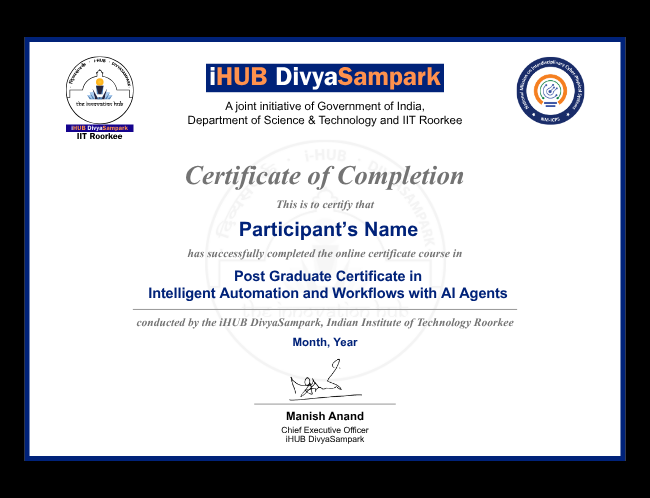
Learners who successfully complete the programme requirements will receive a Post Graduate Certificate in Intelligent Automation and Workflows with AI Agents, issued digitally by iHUB DivyaSampark, IIT Roorkee. The certificate reflects completion of a hands-on programme focused on Enterprise LLMs, Agentic AI, Multi-Agent Systems, workflow orchestration, decision automation, enterprise integration, governance, reliability and security.
To qualify for the certificate, participants must complete all graded mini-projects and assignments with a minimum overall score of 50% and maintain at least 50% attendance in live sessions throughout the programme.
Note:
All certificate images are for illustrative purposes only and may be subject to change at the discretion of iHUB DivyaSampark, IIT Roorkee
We encourage you to attend all the live sessions and make the best out of these interactive learning experiences. Post-session video recordings will be made available, at the discretion of faculty member.
How Is the Intelligent Automation and Workflows with AI Agents Programme Different?
Parameter | Typical Agentic AI Programmes | Intelligent Automation and Workflows with AI Agents Programme |
Automation Scope and Progression | Typically begin with Generative AI, LLMs or autonomous agent development. | Progresses from Python and rule-based automation to adaptive workflows, Enterprise LLMs, Agentic AI and Multi-Agent Systems. |
Workflow-First System Design | Primarily focus on developing agents and connecting them with tools, memory and data sources. | Places AI agents within end-to-end workflows covering state management, orchestration, retries, fallbacks, observability and human checkpoints. |
Hybrid Decision Automation | Commonly focus on LLM reasoning, agent planning and autonomous decision-making. | Combines business rules, machine learning, LLM reasoning and confidence-based human escalation within decision workflows. |
Enterprise System Integration | Commonly cover APIs, external tools and application connections for AI agents. | Covers CRM and ERP integration patterns, APIs, webhooks, event-driven architectures, idempotency, integration testing and failure handling. |
Governance and Human Oversight | Usually address governance through responsible AI, agent controls or deployment-focused topics. | Incorporates autonomy boundaries, approval workflows, audit trails, policy controls and rollback mechanisms into workflow design. |
Reliability and AI Security | Often cover agent evaluation, monitoring and responsible deployment, with varying depth across programmes. | Covers monitoring, distributed tracing, incident response, failure recovery, PII safeguards, access controls, prompt-injection defence and data-leakage prevention. |
Applied Learning | Typically include standalone agent builds, module-level exercises and a capstone project. | Includes 12 mini-projects connected to an enterprise lead management use case, followed by an end-to-end intelligent automation capstone. |
Programme Duration and Fee | Comparable programmes may run for 6 to 7 months, with fees ranging from INR 1,25,000 to INR 1,45,000 plus GST. | Offers a 20-week, live online programme priced at INR 1,09,000 plus GST. |
About iHUB DivyaSampark, IIT Roorkee
iHUB DivyaSampark is a Technology Innovation Hub at IIT Roorkee established under the National Mission on Interdisciplinary Cyber-Physical Systems (NM-ICPS), an initiative of the Department of Science and Technology (DST), Government of India. The hub advances emerging technologies including artificial intelligence, machine learning, robotics, drones, and data analytics through research, innovation, and workforce development. By bringing together academia, industry, and entrepreneurs, iHUB DivyaSampark bridges cutting-edge research and real-world impact, contributing to India's digital transformation agenda.
What Makes It Credible?
Established under NM-ICPS by the Department of Science and Technology, Government of India
Focuses on AI, Industry 4.0, Healthcare 4.0, and sustainable smart cities
Coordinated by a high-level interministerial committee headed by the CEO of NITI Aayog, with participation from MeitY, DST, and other Central Ministries
Emeritus Career Services
Alongside developing expertise in AI- Powered Business Applications, learners gain access to career resources that support professional growth. These recorded sessions focus on helping you showcase your skills, strengthen your online presence, and prepare for future opportunities.
15 Recorded sessions and resources in the following categories (Please note: These sessions are not live):
Resume & Cover
Letter Navigating
Job Search Interview Preparation
LinkedIn Profile Optimisation
Note:
This service is available only for Indian residents enrolled in select Emeritus programmes.
iHUB DivyaSampark, IIT Roorkee or Emeritus do NOT promise or guarantee a job or progression in your current job. Career Services is only offered as a service that empowers you to manage your career proactively. The Career Services mentioned here are offered by Emeritus. iHUB DivyaSampark, IIT Roorkee is NOT involved in any way and makes no commitments regarding the Career Services mentioned here
Frequently Asked Questions About the Post Graduate Certificate in Intelligent Automation and Workflows with AI Agents
What Is the Post Graduate Certificate in Intelligent Automation and Workflows with AI Agents?
The Post Graduate Certificate in Intelligent Automation and Workflows with AI Agents is a 20-week, live online programme by iHUB DivyaSampark, IIT Roorkee, priced at INR 1,09,000 + GST. It helps professionals build enterprise-grade intelligent automation systems using Enterprise LLMs, Agentic AI, Multi-Agent Systems, workflow orchestration and decision automation.
Who Should Enrol in the Intelligent Automation and Workflows with AI Agents Programme?
The Intelligent Automation and Workflows with AI Agents Programme is designed for software developers, RPA professionals, workflow and process automation engineers, AI/ML practitioners, data and integration professionals, enterprise application professionals, and technology and solution consultants.
What Are the Eligibility Criteria for the Intelligent Automation and Workflows with AI Agents Programme?
Applicants must hold a bachelor’s degree or higher. Diploma holders with a minimum of three years of work experience are also eligible. Basic familiarity with programming concepts is recommended
What Are the Duration, Fee, Learning Format and Weekly Time Commitment for the Post Graduate Certificate in Intelligent Automation and Workflows with AI Agents?
The Intelligent Automation and Workflows with AI Agents programme has a duration of 20 weeks, or approximately five months, and is delivered through live online sessions. Participants attend two 3-hour weekend sessions each week and should plan for an overall learning commitment of 8 to 10 hours per week. The programme fee is INR 1,09,000 + GST.
What Will Participants Learn About Intelligent Automation, Enterprise LLMs and AI Agents?
Participants learn to design intelligent workflows, combine rules, machine learning and LLM reasoning for decision automation, and build agentic and multi-agent systems. The programme also covers workflow orchestration, enterprise application integration, human-in-the-loop design, governance, reliability and AI security.
Does this Intelligent Automation programme by iHUB, IIT Roorkee cover AI Governance, Human-in-the-Loop Design and Security?
Yes. The curriculum covers autonomy boundaries, human approval workflows, audit trails, rollback mechanisms and policy controls. Participants also learn about role-based access, PII detection and masking, data minimisation, prompt-injection defence, data-leakage prevention, and DPDP and GDPR considerations.
What AI and Automation Tools are covered in the Intelligent Automation and Workflows with AI Agents Programme by iHUB, IIT Roorkee ?
Participants gain hands-on exposure to 10+ tools, libraries and frameworks, including Python, Visual Studio Code, Postman, GitHub, Pandas, Django, Scikit-Learn, LangChain, LangGraph, LangServe, n8n, Microsoft Presidio and Open Policy Agent. The tools support automation engineering, Enterprise LLM applications, AI agent workflows, integration, governance and security.
Is there a campus immersion during this Intelligent Automation and Workflows with AI Agents?
Yes. Participants who successfully complete the programme can attend an optional 2-day campus immersion at IIT Roorkee’s Noida Campus. The schedule, participation terms and any additional details will be communicated separately.
Elevate your career with this programme!
Flexible payment options available.
Starts On